


Whether you are planning a brand new commercial kitchen fit-out or auditing your existing setup, having a clear equipment list makes the whole process more manageable. There is no shortage of things you could buy for a commercial kitchen. But knowing what you actually need, versus what is nice to have, is what keeps your budget on track and your operation compliant from day one.
This guide covers the essential commercial kitchen equipment list for Australian food businesses, with a focus on what council inspectors look for, what FSANZ requires, and what your team needs to work efficiently.

Commercial Kitchen Fit-Out: What You Must Have Before You Open
Before anything else, understand that in Australia you cannot operate a commercial food business without council approval. Your kitchen must be inspected and registered with your local council's environmental health department before trading begins.
During a fit-out inspection, your council's environmental health officer will check that:
- All food contact surfaces are non-porous, smooth, and easy to clean, including Stainless Steel Benches, food-grade cutting boards, and Food Storage Containers
- Dedicated handwashing facilities are present at each food handling area and cannot be used as prep sinks
- Cold storage holds food at 5 degrees Celsius or below
- The kitchen has adequate ventilation, lighting, drainage, and pest control measures
- Waste disposal is separated from food handling areas
- There is a documented food safety management system in place
Meeting these requirements is not optional. Getting council sign-off before opening saves you from expensive changes after the fact.
The Essential Commercial Kitchen Equipment List
Prep Station Equipment
The prep station is where the majority of your daily food preparation work happens. Getting this area right is the most impactful thing you can do for your kitchen's efficiency and compliance.

Stainless steel prep bench. Grade 304 stainless steel is the industry standard. It meets food-contact surface requirements and is durable, easy to sanitise, and resistant to corrosion. Look for a Stainless Steel Prep Bench with a minimum depth of 600mm, an upstand or splashback, and under-shelf storage for containers and equipment. A product such as the Stainless Steel 304 Bench 1200L x 600W x 900H is a practical option for many commercial prep areas.
Colour-coded polyethylene cutting boards. One board per food type at minimum. The standard colour coding in Australian commercial kitchens is red for raw beef and pork, yellow for raw poultry, blue for raw seafood, green for fruit and vegetables, white for dairy and bakery, and brown for cooked meats.
Prep fridge. A commercial-grade under-counter fridge positioned at or below the bench to keep mise en place cold during service. Must hold between 1 and 4 degrees Celsius consistently.
Food-grade containers with lids. One of the most used items in any commercial kitchen prep station and one of the most commonly underestimated. Use Food Storage Containers in a range of sizes from 500ml to 10L with matching tight-fitting lids. For food-safe prep and storage, Food Grade Plastics are a practical choice, and a kit such as the Complete Clear Polycarbonate Food Storage Container Kit can help standardise your setup.
Digital scales. Accurate to at least 1 gram for portioning and recipe consistency.
Knife set. A chef's knife, paring knife, bread knife, and filleting knife as a minimum. Allocated to the station and stored on a magnetic strip or in a blade guard.
Colour-coded utensils. Tongs, spatulas, and spoons allocated to specific food types to prevent cross-contamination.
Stainless steel mixing bowls. Multiple sizes from small to large. Stainless steel is preferred over plastic for bowls used directly at the prep bench because it is more durable and easier to sanitise.
Bench scraper. Used for portioning dough, scraping boards, and general prep tasks.
Cold Storage Equipment
Commercial cool room or upright refrigerator. For bulk cold storage of raw ingredients and prepped batches. Must maintain 5 degrees Celsius or below. Organise with raw proteins on the bottom shelf and ready-to-eat food on shelves above.
Commercial freezer. For long-term frozen storage. Upright freezers are easier to organise and access. Chest freezers offer more capacity per dollar.
Prep fridge at each active station. Separate from the main cool room.
Food-grade containers with lids for all stored items. Every container in a fridge or cool room must be labelled with the content, preparation date, and use-by date. A container such as the 3.8L Clear Polycarbonate Food Storage Container is well suited to everyday fridge and cool-room storage.
Cooking Equipment
Cooking equipment varies significantly depending on your menu type and kitchen size. The typical commercial kitchen includes a gas or electric range with four to eight burners, a commercial convection or combi oven, a commercial grill or griddle, a deep fryer where the menu requires it, and a salamander or broiler for finishing.
All cooking equipment must be installed by a licensed tradesperson and comply with the relevant gas and electrical installation standards.
Shelving and Dry Storage
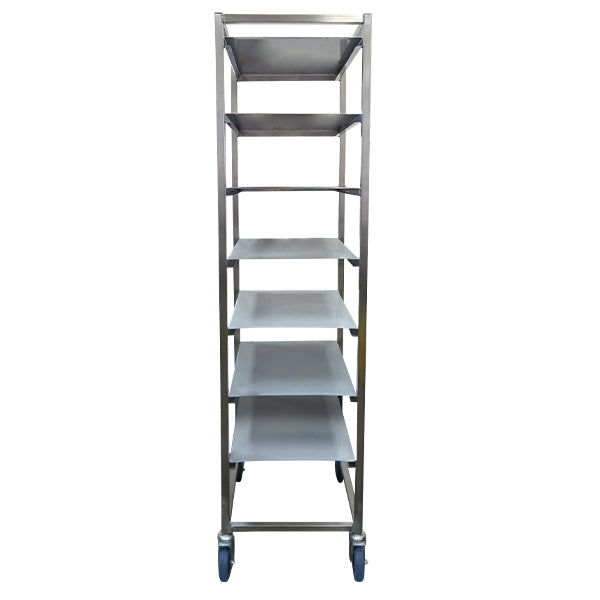
Commercial wire or stainless steel shelving. All food must be stored at least 15cm off the floor. Stainless steel or chrome wire shelving is the standard in Australian commercial kitchens. Good Shelving & Racking should be positioned to allow airflow and easy cleaning underneath.
Sealed dry storage containers. For pantry items including flour, sugar, salt, rice, and dried goods. Food-grade containers with tight-fitting lids prevent pest access and keep ingredients fresh. For bulk dry-goods handling, Food Ingredient Bins and Mobile Ingredient Bins make it easier to store, move, and portion high-volume ingredients.
Commercial shelving in cool rooms. Cool-room shelving must also be commercial-grade and easy to clean. Wire shelving allows airflow around stored items, which supports consistent refrigeration. For a broader fit-out, the Benches, Shelving & Sinks range can help cover several core kitchen areas.
Sanitation Equipment
Dedicated handwash basin at each food handling area. This is a legal requirement. The basin must be used only for handwashing and must always have liquid soap and paper towels or a dryer immediately available.
Commercial dishwasher. Must achieve sanitisation through either high-temperature washing or an approved chemical sanitising rinse.
Three-compartment sink. For manual washing, rinsing, and sanitising of items that cannot go through the dishwasher.
Food-safe sanitiser and spray bottles at each prep station. Surfaces must be sanitised between tasks, not just at the end of service.
Food Safety and Compliance Equipment
Digital probe thermometer. For checking the internal temperature of cooked food and the temperature of stored ingredients. Must be calibrated and food-safe.
Temperature log and monitoring system. Paper logs or digital systems for recording fridge and cool room temperatures at least twice daily.
Food safety documentation. A documented food safety management plan covering your food safety procedures, temperature monitoring, cleaning schedule, and corrective action processes.
Labelling system at each prep station. Label dispensers, printed labels, or a whiteboard marker system. Every container must be labelled with content, preparation date, and use-by date.
Minor Equipment That Makes a Big Difference
- Cling film and foil dispensers at the prep station
- Portion bags and zip-lock bags in commercial quantities
- Timers visible from the prep station and cooking line
- First aid kit mounted in the kitchen and easily accessible
- Cut-resistant gloves and heat-protection gloves for staff
- Cleaning schedule and food safety documents laminated and posted at relevant stations
What Are the Commercial Kitchen Requirements in NSW and QLD?
The national food safety standards apply across all states and territories. However, state-specific food acts and local council requirements add additional layers.
In New South Wales, food businesses must notify the NSW Food Authority or local council before commencing operation. Many businesses also need a Food Safety Supervisor who holds a current qualification.
In Queensland, food businesses must be registered with their local council. A Food Safety Supervisor is required for businesses that handle unpackaged potentially hazardous food.
In both states, local council requirements for fit-out approval vary. Always check with your local council's environmental health department before beginning any fit-out work.
How to Budget for a Commercial Kitchen Equipment List
If you are fitting out a commercial kitchen on a budget, prioritise in this order.
First, compliance-critical equipment. Your prep fridge, handwashing basins, temperature monitoring equipment, food-grade containers, and food safety documentation are not optional.
Second, your cooking line. The specific cooking equipment you need depends entirely on your menu. Do not over-invest in cooking equipment before your menu is finalised.
Third, storage and shelving. A well-organised storage system reduces waste, supports FIFO, and makes your team more efficient every day. Invest in durable Food Storage Containers, bulk Food Ingredient Bins, and reliable Shelving & Racking so ingredients are easy to access, rotate, and keep off the floor.
Fourth, minor equipment. Most minor equipment can be added progressively once you are trading.